











Planning a European road trip across borders
A practical guide to vignettes, toll systems and what to prepare before crossing multiple countries.
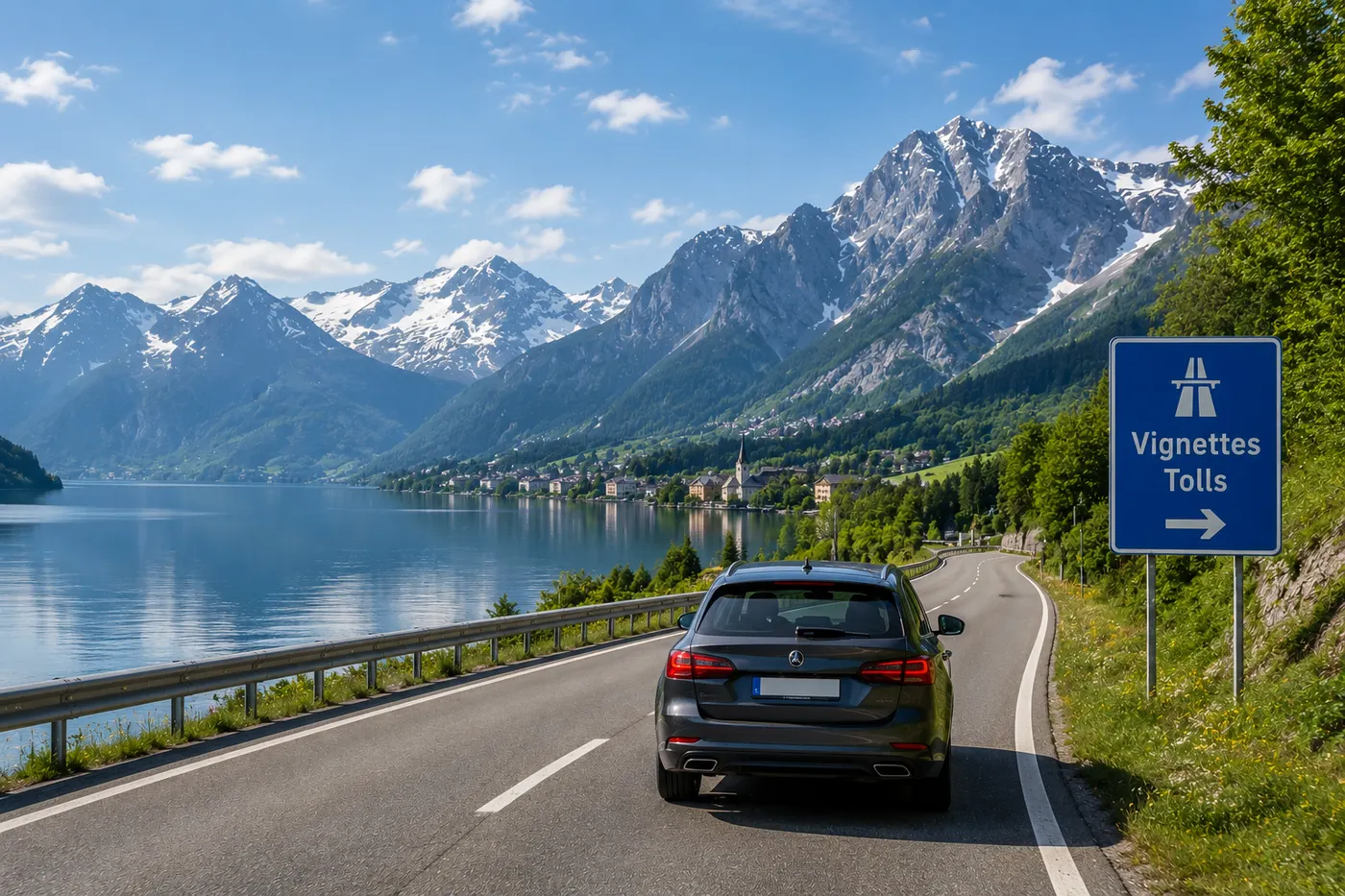
Driving across Europe sounds simple until you actually plan the route. You cross from Germany into Austria and suddenly need a vignette. You continue into Switzerland and the rules change again. Add Hungary, Slovenia or the Czech Republic, and you're juggling three or four different payment systems before lunch.
None of this is complicated on its own. The trouble is that every country handles road access differently, and almost nobody explains it before you're already at the border.
What is a vignette, exactly?
A vignette is a road toll sticker or digital pass that gives you the right to drive on motorways in a given country. Some countries sell a physical sticker for your windscreen. Others, like Austria and Switzerland, now also offer a digital version tied to your license plate, which you buy online before you travel.
The catch is that a vignette is not the same as a toll. In countries like Austria, France or Italy, you can owe both: a vignette for the motorway network in general, plus separate tolls for specific tunnels, bridges or sections of road. Skipping either one usually means a fine, and traffic cameras at the border are good at catching it.
Vignette vs. toll: two different systems
It helps to think of these as two separate charging models rather than variations of the same thing.
Vignette countries charge a flat fee for a period of time (10 days, a month, or a year), regardless of how far you drive. Austria, Switzerland, Slovenia, Hungary, the Czech Republic, Slovakia, Romania and Bulgaria all use this model for at least part of their motorway network.
Toll countries charge based on distance, usually collected at toll booths or via an electronic tag. France, Italy, Spain and Portugal mostly work this way, sometimes combined with a separate transponder system for faster lanes.
A few countries mix both. Austria has a vignette for the standard motorway network and additional tolls for major tunnels like the Brenner or Karawanken. If you only budget for one, you'll be short at the tunnel.
Building your route before you drive
The easiest way to avoid surprises is to map your route before you leave, not after you've crossed a border and seen a sign you don't recognize.
Start by listing every country your route touches, including short stretches. A trip from Munich to Venice, for example, might only clip a small part of Austria near the Brenner Pass, but that stretch still needs a valid vignette.
Then check two things for each country: whether it uses a vignette, a toll, or both, and how long you actually need coverage for. A one-way trip through a country you'll pass in an afternoon doesn't need a full annual vignette. Most countries sell short-term options, usually 10 days or a month, which is enough for a single trip and considerably cheaper than the yearly rate.
What to have ready before you cross
A few details make the actual purchase faster, whether you're buying at a border kiosk, a petrol station, or online in advance:
- Your license plate number, exactly as it appears on the vehicle
- The vehicle's registration country
- Vehicle category and, in some countries, emissions class, since heavier or older vehicles sometimes pay more
- Your planned dates of travel, if you're buying a time-limited pass rather than a full year
Digital vignettes are usually tied to the plate rather than a physical sticker, so once you've bought one, there's nothing to display on the windscreen. That's convenient, but it also means you should keep your confirmation email or receipt somewhere accessible. If a roadside check can't find your plate in the system for any reason, you'll want proof of purchase on hand.
Timing matters more than people expect
Some countries activate a vignette immediately on purchase; others start it from a date you select, or from midnight the day after you buy it. Switzerland's sticker system, for instance, runs on the calendar year regardless of when you buy it, while other countries' digital passes activate from your chosen start date. Buying the day before you leave isn't always the same as buying the day you cross the border, so it's worth checking the specific activation rule for each country rather than assuming they all work the same way.
A short route example
Say you're driving from Berlin to Lake Garda in Italy. Along the way, you'll pass through Austria and possibly touch a corner of Switzerland or Slovenia depending on your exact route, before crossing into Italy.
That means: an Austrian vignette (short-term is fine for a single pass-through), separate toll payments for any Alpine tunnels you use, and Italy's distance-based toll system, which you pay at booths as you go. If your route runs through Switzerland instead of skirting it, add a Swiss vignette, which is sold on a calendar-year basis with no short-term option.
None of this needs to be memorized. It just needs to be checked once, for your specific route, before you leave.
The main thing to get right
The single most common mistake isn't forgetting a vignette entirely. It's assuming that one country's system tells you anything about the next one. Buying an Austrian vignette doesn't cover Switzerland. A French toll tag doesn't work in Italy. Each border is its own small piece of admin, and the only way to avoid dealing with it at the worst possible moment, at a checkpoint, with a queue behind you, is to sort it out before you start driving.